AnyPS5 doesn't emulate your PS5 — it tries to make PS5 games run on your PC
AnyPS5 is an open-source project that takes a different approach to running PlayStation 5 games on Windows and Linux. Its latest graphics milestone is real progress, but there's still a long way to go before most games will work.
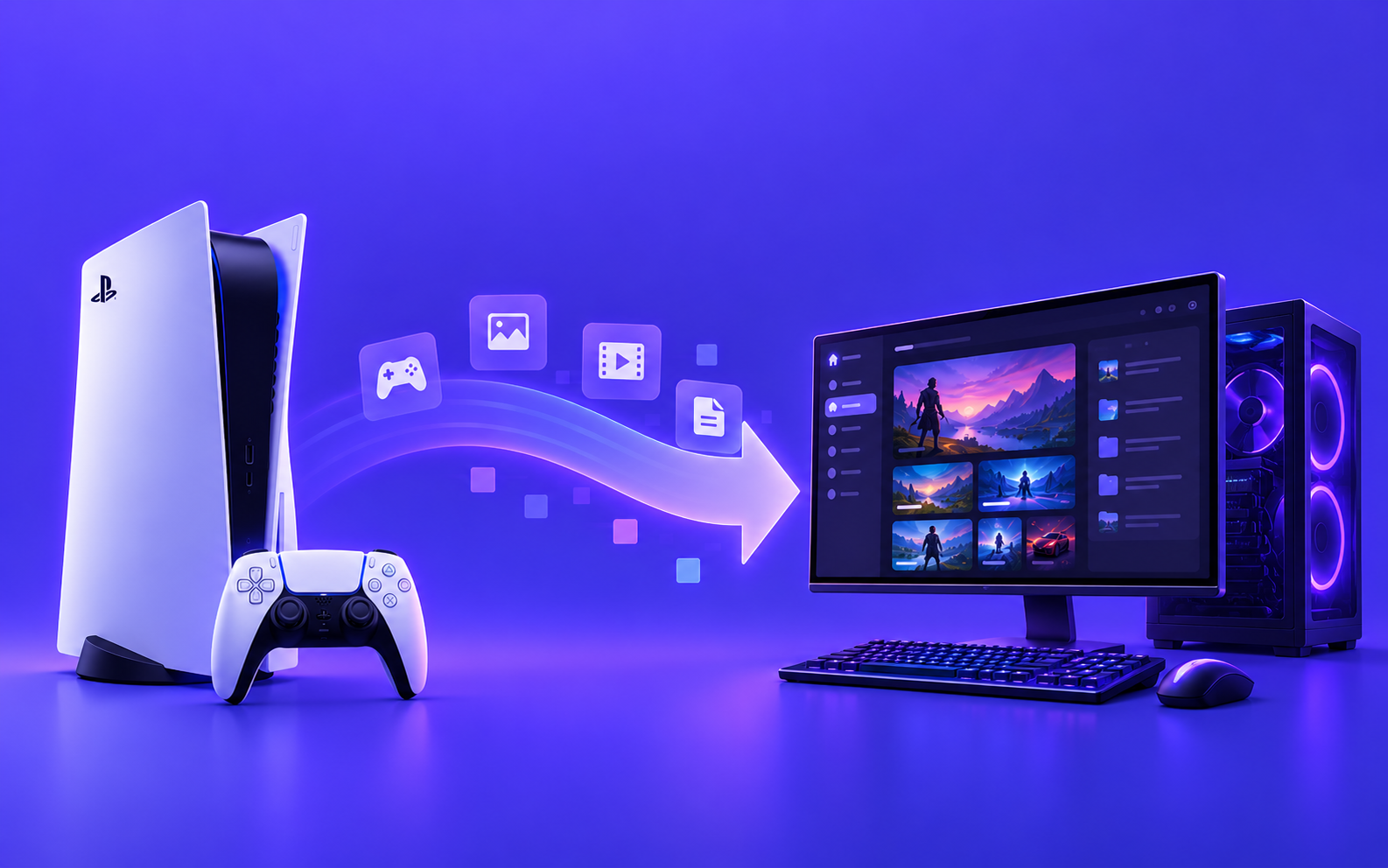
Original illustration by Plugd. Not affiliated with Sony, PlayStation, or the AnyPS5 project.
What if you could run a PS5 game on your PC without running a full PS5 emulator?
That's the idea behind AnyPS5, an open-source project that's getting attention for how it approaches the problem. Instead of recreating an entire PlayStation 5 in software, it tries to convert a game's executable so it can run as a native Windows or Linux program.
It's a different way to approach console compatibility. And the project has made some interesting progress.
But there's an important detail: getting a game to start isn't the same as getting it to work properly. Right now, only one game is listed as officially verified and fully playable by the project.
Here's how AnyPS5 works, what's changed recently, and what still needs to happen.
How AnyPS5 works
It changes the program instead of recreating the console
A traditional emulator recreates enough of a console's hardware and software for its games to run. That can involve translating instructions, handling memory, and reproducing how the original hardware behaves.
AnyPS5 takes a different route.
The PS5 uses an AMD Zen 2 processor with the x86-64 instruction set. Modern desktop PCs use the same basic instruction set, although compatibility still depends on the processor and the software around it.
This gives AnyPS5 a useful starting point. Rather than having to emulate the PS5's entire CPU, it can adapt much of the game's existing machine code for a compatible PC.
The project then replaces the system libraries the game expects from Sony's software with its own implementations.
Think of it this way: the game still contains its original code, but the parts that expect a PS5 need a replacement that works on the computer running it.
That's why the project describes its approach as native porting rather than conventional emulation. It doesn't rebuild the game from source code, either. It works with the compiled executable.
The approach is promising, but sharing a CPU instruction set doesn't make two systems automatically compatible. The operating system, graphics, memory, audio, and other services still need to work.
Source: AnyPS5 architecture documentation.
The three main challenges
1. Converting the executable
AnyPS5 has a component called a relinker. It takes a PS5 executable and converts it into a format that Windows or Linux can load.
It also handles the links between the game and the system functions it expects to use.
For example, a program might ask the console's operating system to perform a task. On a PC, that request needs to reach a compatible implementation instead.
This is one of the first hurdles. If the program can't be loaded or its dependencies can't be resolved, the game won't get very far.
2. Replacing the PS5 system libraries
Games rely on much more than their own code. They also call system libraries for things like audio, networking, file access, and graphics.
AnyPS5 is building replacements for these libraries so that the game can call into code that runs on the host computer.
This is a large amount of work. A function existing in the project doesn't necessarily mean it behaves exactly like the original PS5 version. Some functions may only cover part of what a game needs.
That's why library coverage figures need context. They describe the functions the project has mapped and implemented, not the percentage of all PS5 games that will work.
3. Getting the graphics to work
Graphics are another major challenge.
PS5 games use Sony's graphics interface and AMD RDNA-specific shader instructions. A PC running AnyPS5 needs a way to translate those shaders into a format that works with its graphics stack.
The project uses Vulkan and translates shader programs into SPIR-V, a format that Vulkan implementations can use.
On October 10, Tom's Hardware reported that the project's shader decoder covered all 1,166 instructions in its tracked RDNA 1 and RDNA 2 instruction set.
That's an important milestone, but the number needs to be understood correctly.
Recognizing an instruction is only one step. The project still needs to translate it correctly, reproduce the expected graphics behavior, and handle the rest of the game's rendering pipeline.
In other words, 100% instruction coverage doesn't mean 100% GPU compatibility.
Source: Tom's Hardware, October 10, 2026.
What games can you play right now?
This is where expectations need to stay realistic.
AnyPS5 has released early versions of its software, including v0.1.1 in September 2026. The project is still developing its core features, and its compatibility list shows how much work remains.
The official compatibility list identifies Dreaming Sarah, a small 2D platformer, as its verified playable game. The project reports that it runs at a stable 60 frames per second on a tested PC.
Other games have reached different stages. Some can be converted, some start, and others show menus or render a few frames. A smaller number of experimental tests reach gameplay.
But these results aren't all equal.
A game that displays its opening logo may still fail when it loads a level. A game that reaches gameplay might have broken graphics, missing audio, poor performance, or crashes.
Some community reports also rely on experimental branches and local patches that aren't part of the main project. Those results are useful for development, but they shouldn't be treated as proof that the standard release can run the game.
So, if you see a claim that a major PS5 game is now playable on PC, check which build was tested and what the person actually managed to do.
For now, AnyPS5 is a working proof of concept, not a replacement for your PS5.
Source: AnyPS5 development progress tracker.
There's a legal issue, too
The technical side isn't the only thing worth considering.
AnyPS5 says it doesn't distribute PS5 games, firmware, encryption keys, or Sony's proprietary libraries. Its system-library implementations are written separately.
That's an important distinction. Building an independent compatibility tool raises different questions from distributing copyrighted game files or copying proprietary code.
However, the tool still needs suitable game files to work with. Obtaining a usable, decrypted executable can involve technical steps that raise separate legal questions.
In the United States, Section 1201 of the Digital Millennium Copyright Act restricts certain forms of circumventing technological protection measures. The law also includes specific exceptions, including provisions related to interoperability. Whether an exception applies depends on the circumstances.
Owning a game doesn't automatically settle every legal question, and a tool's open-source status doesn't make every possible use lawful.
The rules also differ between countries. Anyone considering using software that requires bypassing console protections should understand the laws that apply to them.
This isn't a reason to dismiss the engineering work. It is a reason to keep the tool's legality, the source of the game files, and the way the software is used as separate questions.
Source: US Code, Section 1201.
Why the project still matters
There are two reasons to pay attention to AnyPS5, even if you're not planning to run a game through it today.
Game preservation
Games can become difficult to access as consoles age, storefronts close, and hardware fails.
A tool that helps games run on ordinary computers could eventually make some titles easier to preserve. It could also reduce dependence on the original console hardware.
That future isn't guaranteed. Games may still depend on online services, proprietary components, or features that are difficult to reproduce. Legal restrictions can also limit what people can do.
But working on compatibility is a worthwhile part of the wider game-preservation effort.
A different approach to PC gaming
Console games and PC games often share similar underlying hardware, but the software built around them can be very different.
AnyPS5 is exploring whether those differences can be handled without recreating an entire console in a traditional emulator.
If the project matures, it could provide a way to create native PC versions of some games without access to their original source code.
That would be a meaningful technical achievement. It could also give preservation researchers and developers another way to study how games work.
But it is too early to know how far the project will go or how many commercial games it will eventually support.
What's next for AnyPS5?
The next important milestone isn't another big percentage or a larger compatibility list.
It's getting more games to work reliably on the standard project build.
That means fixing missing system functions, improving graphics support, handling memory correctly, and testing complete games rather than just their opening screens.
It also means making results easier to reproduce. A game that works only with a collection of private patches is useful evidence of progress, but it's not the same as broad support in a public release.
The project's shader work shows that its developers are making progress on difficult parts of the problem. The single verified playable game also gives us a concrete starting point.
There is still a lot to do.
AnyPS5 is worth following because of the work it is doing, not because it can already run every PS5 game.
For now, treat it as an early open-source experiment with a promising technical approach. If compatibility improves over time, it could become useful for PC gaming and game preservation. But there's no reason to expect your entire PS5 library to work on your computer today.